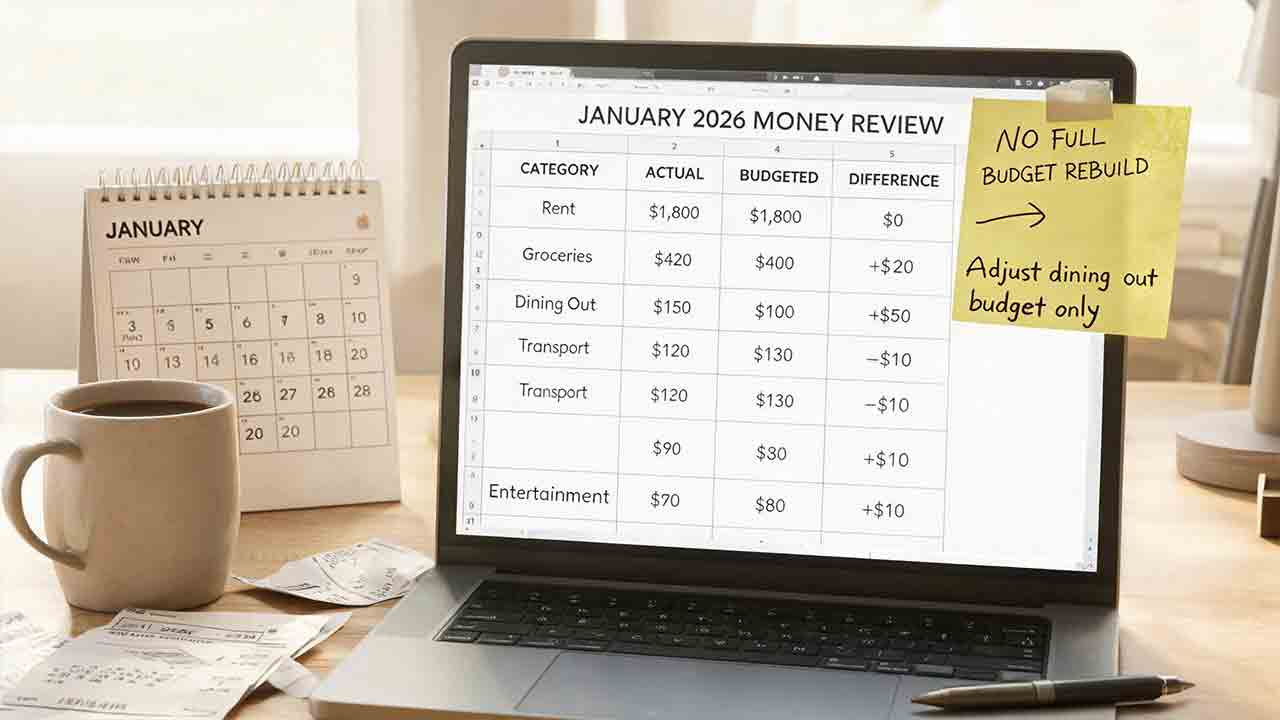
January can make money feel louder than usual.
Holiday charges may still be visible. New-year bills begin arriving. Tax documents start to appear. Insurance renewals, school expenses, subscription renewals, and annual memberships can all crowd into the same season. At the same time, many people feel pressure to become a completely different version of themselves: more organized, more disciplined, more frugal, more intentional.
That pressure often leads to one mistake: trying to rebuild the entire budget from scratch.
A full budget rebuild can be useful for some households, but it is not the only way to start the year well. Many people do not need a brand-new system in January. They need a practical money review that catches the obvious leaks, reduces confusion, and makes the next month easier.
This article is built around a smaller, more realistic question:
What needs attention now so money does not become harder to manage later?
You do not need to relive every purchase from last year. You do not need to assign every dollar for the next twelve months. You do not need a perfect spreadsheet, a paid app, or a dramatic financial reset.
You need a short review that identifies friction.
Friction is the bill you forgot was annual. Friction is the subscription that kept renewing after you stopped using it. Friction is the tax form you know will be needed later but cannot find. Friction is the credit card autopay date that lands too close to rent week. Friction is the savings goal that sounds good but has no next step. Friction is the household money conversation everyone keeps postponing.
A January money review works best when it feels like maintenance, not punishment. The goal is not to prove that last year was good or bad. The goal is to make the current year less confusing.
Who This Article Is / Is Not For
This article is for you if:
- You want a January money reset without rebuilding your entire budget.
- You prefer short, practical review steps over a complicated tracking system.
- Your household finances are mostly manageable but messy in a few places.
- You want to catch forgotten bills, recurring charges, paperwork gaps, and timing problems early.
- You want a legally safe household finance guide that does not promise guaranteed savings.
- You want a money review that can be done in small sessions instead of one long budgeting day.
This article is not for you if:
- You need personalized investment, tax, legal, bankruptcy, or debt settlement advice.
- You are facing urgent hardship such as eviction, foreclosure, repossession, wage garnishment, or a lawsuit.
- You need a full business accounting system.
- You want a complete zero-based budget where every dollar is assigned.
- You are looking for credit repair promises, tax loopholes, stock picks, crypto advice, or borrowing strategies.
If your situation is urgent or complex, this article may still help you organize information, but it should not replace help from a qualified professional, nonprofit credit counselor, attorney, tax preparer, financial planner, or local assistance program. ---
Start Here: The 25-Minute January Money Review
Use this short version first. You can return to the full article later for more detail.
1. Cash-flow check, 5 minutes
Write down:
- Your usual monthly take-home income
- Your fixed monthly bills
- Any irregular expenses due in January or February
- One bill that feels too high
- One part of last month’s spending that felt unclear
Do not solve everything yet. Just mark the pressure points.
2. Subscription and autopay check, 5 minutes
Review bank and card activity for recurring charges. Mark each one as:
- Keep
- Cancel
- Downgrade
- Question
- Annual renewal risk
Look especially for free trials, cloud storage, streaming services, delivery memberships, apps, software, children’s subscriptions, and duplicate services.
3. Paperwork folder, 5 minutes
Create one folder named:
2026 Money Documents
Inside it, make simple sections:
- Taxes
- Insurance
- Housing
- Debt and loans
- Bank and card statements
- Receipts for major purchases
- Benefits and workplace documents
Digital is fine. Paper is fine. Mixed is fine. The goal is findability, not beauty.
4. Protection check, 5 minutes
Check:
- Credit report access
- Bank alerts
- Card alerts
- Secure password storage
- Insurance renewal dates
- Emergency contact information
- Important account recovery details
The Federal Trade Commission explains how consumers can access free credit reports through the authorized free credit report source in its guide to [free credit reports](https://consumer.ftc.gov/articles/free-credit-reports).
5. One decision, 5 minutes
Choose one action for this week:
- Cancel one unused recurring charge.
- Save one missing document.
- Set one bill reminder.
- Compare one recurring bill.
- Check one credit report.
- Update one account password.
- Increase emergency savings by a small automatic amount.
- Schedule one tax paperwork review.
A January review is successful if it produces one clear next step. It does not need to produce a perfect financial system.
Why January Works for a Money Review
January has a natural paperwork advantage.
Many households are already dealing with year-end statements, new insurance cards, tax forms, benefits updates, school payments, holiday spending aftermath, and calendar-year renewals. That makes January a useful time to look at money systems before small problems become larger ones.
But January also has an emotional disadvantage.
People often begin the year feeling guilty about holiday spending or pressured to make dramatic improvements. That can lead to overcorrection. A household may cancel too much, set savings goals that are too strict, or build a budget that only works on paper. Another household may avoid the process entirely because the numbers feel uncomfortable.
A better approach is review without punishment.
The purpose of a January money review is not to judge last year. It is to create a cleaner handoff into this year. Think of it like clearing a kitchen counter before cooking. You are not redesigning the whole kitchen. You are making enough space to work.
The DailyMoneyHabits January Drift Map
Most budget advice starts with categories: housing, food, transportation, debt, savings, and entertainment. Those categories matter, but they do not always explain why households lose track of money.
A more useful January lens is “drift.”
Drift is the gap between what you think your money system is doing and what it is actually doing.
A January review should look for five types of drift.
1. Payment drift
Payment drift happens when bills, subscriptions, and autopay dates move away from your memory.
Examples include:
- A subscription renewed annually instead of monthly.
- A utility bill increased after a promotional period.
- A card on file changed, but the account was never updated.
- A payment date moved close to rent or mortgage week.
- A buy-now-pay-later payment was forgotten.
- A bill moved from manual payment to autopay without a clear reminder.
Payment drift can create late fees, overdraft risk, missed payments, and avoidable stress.
The January fix is not always to cancel something. Sometimes the fix is to move a due date, add a reminder, update the card on file, or keep a larger checking buffer during the tightest week of the month.
2. Paperwork drift
Paperwork drift happens when documents exist but are not easy to find.
Examples include:
- Tax forms scattered across email, mail, employer portals, and bank websites.
- Insurance documents saved in different places.
- Receipts for major purchases missing.
- Loan documents stored under unclear file names.
- Medical, childcare, or dependent-care receipts not grouped.
- Warranty details lost after a large household purchase.
Paperwork drift wastes time later, especially during tax season, insurance claims, disputes, loan applications, rental applications, or benefit reviews.
The January fix is a simple folder system. It does not need to be fancy. It needs to be obvious enough that you will use it when you are tired.
3. Lifestyle drift
Lifestyle drift happens when a temporary spending pattern quietly becomes normal.
Examples include:
- More takeout after a stressful month.
- Extra delivery fees because convenience became routine.
- More impulse purchases because saved card details make checkout too easy.
- Upgraded memberships that no longer feel special.
- Holiday spending habits continuing into January.
- Small “reward” purchases becoming a weekly pattern.
Lifestyle drift is not always bad. Sometimes life changes and spending should change. The problem is when spending changes without a decision.
The January fix is to ask:
Do we still choose this, or did it simply become automatic?
That question is less judgmental than “Why did we spend so much?” It helps separate real value from quiet habit.
4. Protection drift
Protection drift happens when financial safety settings fall behind your real life.
Examples include:
- Weak passwords on bank or card accounts.
- No transaction alerts.
- Old phone numbers on account profiles.
- Credit reports not reviewed.
- Insurance coverage not reconsidered after a move, marriage, child, vehicle change, or major purchase.
- Emergency contacts out of date.
- Important accounts missing recovery options.
Protection drift is easy to ignore because nothing feels wrong until something goes wrong.
The January fix is a short protection check: alerts, passwords, credit reports, insurance dates, and account recovery details.
5. Goal drift
Goal drift happens when goals sound meaningful but are not connected to a next step.
Examples include:
- “Save more this year.”
- “Pay down debt.”
- “Spend less on food.”
- “Be better with money.”
- “Start investing someday.”
- “Stop wasting money.”
These goals may be sincere, but they are too vague to guide behavior.
The January fix is to turn one goal into one small action. “Save more” becomes “transfer $25 every payday.” “Spend less on food” becomes “plan two low-effort dinners before grocery shopping.” “Pay down debt” becomes “write down balances, minimum payments, due dates, and interest rates before choosing a method.”
A goal does not need to be huge to be real. It needs a next step.
Step 1: Take a Cash-Flow Snapshot
Start with a snapshot, not a full budget.
A full budget tries to assign money before it is spent. A snapshot simply shows what is already true.
Write down four numbers: 1. Expected take-home income for a normal month 2. Fixed monthly bills 3. Minimum debt payments, if any 4. Known irregular expenses due in the next 60 days
Then ask:
What is the tightest week of the month?
This question is often more useful than asking whether the whole month “works.” Many households technically have enough money over the full month but struggle because bills are clustered in one difficult stretch.
For example, rent, car payment, insurance, and a student loan payment may all hit within ten days. The monthly total may be manageable, but the timing creates stress.
You do not need to rebuild your entire budget to improve this. You might:
- Move one due date if the provider allows it.
- Set aside a small amount each paycheck for an annual bill.
- Add a reminder three days before a large autopay.
- Keep a small checking buffer.
- Move a subscription away from rent week.
- Avoid flexible purchases during the tightest week.
- Pay one predictable bill slightly earlier if that reduces stress.
This is a practical January win: not spending less through shame, but reducing timing friction. ---
Step 2: Review Subscriptions Without Making It Personal
Subscription reviews can become emotional. People often feel foolish when they find unused services. That feeling does not help.
A subscription is not a character flaw. It is a billing arrangement that may or may not still fit your life.
Open the last 60 to 90 days of bank and credit card activity. Search for recurring charges. Useful search words include:
- Monthly
- Annual
- Subscription
- Membership
- Premium
- Cloud
- Storage
- App
- Delivery
- Streaming
- Trial
- Renewal
Sort each charge into one of five groups.
Keep
This service is used, valued, and affordable.
Cancel
This service is not used or no longer worth the cost.
Downgrade
The service is useful, but the current tier is more than you need.
Question
You do not recognize the charge or need to ask another household member.
Annual renewal risk
You want the service now, but a future annual renewal could surprise you.
The “annual renewal risk” group is easy to miss. A service can be worth keeping and still need a reminder before it renews.
The best subscription review does not ask, “Can I cancel everything?” It asks:
Which recurring charges still deserve permission to continue?
That wording matters. It turns the review from guilt into consent.
Step 3: Build a Simple January Paperwork Folder
A good money folder does not need to be beautiful. It needs to be boring, obvious, and easy to use.
Create one folder called:
2026 Money Documents
Then create subfolders or envelopes for:
- Taxes
- Pay and income
- Housing
- Insurance
- Debt and loans
- Banking
- Credit cards
- Major receipts
- Benefits
- Medical or dependent-care expenses, if relevant
- School or childcare expenses, if relevant
Do not over-design the system. If you create too many folders, you may stop using it. If you create one messy folder, you may not find anything. Aim for enough structure to reduce searching.
For tax-related organization, the IRS provides official taxpayer resources at [IRS.gov](https://www.irs.gov/). If you need to review federal withholding, the IRS offers a [Tax Withholding Estimator](https://www.irs.gov/individuals/tax-withholding-estimator). This article does not tell you how much to withhold or how to file taxes; it only encourages keeping official documents findable.
A January folder can help with:
- Tax preparation
- Insurance claims
- Warranty claims
- Loan applications
- Rental applications
- Financial aid paperwork
- Benefits enrollment
- Merchant disputes
- Household planning conversations
The folder is not just for taxes. It is a memory tool for your future self.
Step 4: Check Credit Reports the Low-Drama Way
A credit report check does not need to be scary or complicated.
The purpose is to look for accuracy, unfamiliar accounts, identity issues, and information that may affect borrowing, housing, insurance, or other financial checks where applicable.
The Federal Trade Commission explains free credit report access in its guide to [free credit reports](https://consumer.ftc.gov/articles/free-credit-reports). You do not need to pay for add-ons just to review your reports.
A January credit report check can be simple:
- Confirm your name and identifying information are correct.
- Look for accounts you do not recognize.
- Check whether closed accounts are marked accurately.
- Review balances and payment history for obvious errors.
- Save notes about anything you may need to dispute.
- Avoid entering personal information on look-alike websites.
This is not about obsessing over a score. Credit scores can vary by model, lender, and timing. The report is the underlying record. Reviewing it periodically is a protection habit.
If you find an error, follow the dispute instructions from the credit reporting company and keep copies of what you send. If you suspect identity theft, use official government resources rather than random search results or paid “repair” promises.
A safe January rule is:
Check the record before you worry about the number.
Step 5: Review Emergency Savings Without Shame
Emergency savings advice often becomes unrealistic. Many people hear a large target and immediately feel behind.
A January review should begin smaller.
Ask:
What is the first emergency that would cause me to use a credit card, borrow money, miss a bill, or panic?
That answer might be:
- A car repair
- A prescription
- A pet expense
- A missed work shift
- A school fee
- A utility spike
- A small medical bill
- A phone replacement
- A travel emergency
- A child-related expense
Once you name the first likely emergency, choose a starter savings target connected to real life. It might be $100, $250, $500, or another amount. The number should be meaningful but not impossible.
The Consumer Financial Protection Bureau offers consumer education on building emergency savings in its [emergency fund guide](https://www.consumerfinance.gov/an-essential-guide-to-building-an-emergency-fund/).
For a January review, the most useful emergency savings question is not, “Do I have enough?” It is:
What is the next realistic layer of protection?
That might mean setting an automatic transfer, moving savings to a separate account, keeping the money away from everyday spending, or using part of an expected refund or bonus carefully if one arrives.
Emergency savings works best when it is treated as a buffer, not a scoreboard.
Step 6: Create a One-Page Bill Calendar
A bill calendar is one of the easiest ways to improve money visibility without building a full budget.
Make a simple list with five columns:
| Due Date | Bill | Usual Amount | Payment Method | Stress Level |
|---|
| 1st | Rent or mortgage | $____ | Manual / autopay | Low / Medium / High |
| 5th | Car payment | $____ | Manual / autopay | Low / Medium / High |
| 12th | Phone | $____ | Manual / autopay | Low / Medium / High |
| 18th | Credit card minimum | $____ | Manual / autopay | Low / Medium / High |
| 25th | Insurance | $____ | Manual / autopay | Low / Medium / High |
The stress-level column is what makes this more useful than a normal bill list. Two bills with the same dollar amount can feel very different depending on timing, income schedule, and household context.
A $90 bill during a comfortable week may be low stress. A $90 bill two days before rent may be high stress.
Once you mark the stress level, look for small adjustments:
- Move a due date.
- Add a reminder.
- Change payment method.
- Split an annual cost into monthly savings.
- Keep a checking buffer.
- Move a flexible purchase away from that week.
- Ask the provider about billing options.
The bill calendar does not need to predict the whole year. It only needs to show where the month gets tight.
Step 7: Choose One No-Rebuild Money Rule
A full budget rebuild often fails because it adds too many rules at once.
A January review works better with one rule that is easy to remember.
The 24-hour rule
For non-urgent purchases above a chosen amount, wait 24 hours before buying.
The one-in, one-out subscription rule
Before adding a new paid subscription, cancel or downgrade one existing recurring charge.
The rent-week quiet rule
During the week rent or mortgage is due, avoid non-essential large purchases.
The receipt rule
For purchases above a chosen amount, save the receipt in your 2026 Money Documents folder.
The Friday five rule
Every Friday, spend five minutes checking balances, upcoming bills, and one transaction you do not recognize.
The annual reminder rule
Any annual renewal gets a calendar reminder 14 days before it charges.
The best rule is not the strictest one. It is the one you will actually use in March when January motivation is gone.
What NOT To Do / Common Mistake
Mistake 1: Rebuilding the entire budget because one category feels bad
Overspending in one area does not always mean your whole system is broken. It may mean one category needs attention.
If food spending rose, review food routines. If subscriptions grew, review subscriptions. If bills feel late, review due dates. Do not redesign everything before you know where the friction is.
Mistake 2: Setting a savings goal with no transfer plan
“Save more” is not a plan. A plan needs an amount, timing, account, and trigger.
A clearer version is:
“I will transfer $25 to savings every payday starting January 16.”
Even if the amount is small, the system is real.
Mistake 3: Canceling useful services too aggressively
Cutting expenses can help, but canceling tools your household truly uses may create hidden costs.
For example, canceling a grocery delivery membership might save a fee but increase transportation stress for someone without reliable access to a car. Canceling a cloud storage plan might save money but create document problems later.
Review value, not just price.
Mistake 4: Ignoring annual costs
Monthly budgets often miss annual or semiannual expenses. Insurance premiums, memberships, school costs, vehicle registration, software renewals, property-related fees, and professional licenses can surprise households that only think month to month.
Create a small annual-cost list in January. It does not have to be perfect. Even a partial list is better than being surprised later.
Mistake 5: Treating credit score anxiety as a money plan
Credit matters, but watching a score is not the same as managing money. Review reports for accuracy, pay bills on time when possible, understand debt terms, and avoid expensive promises from companies that claim quick fixes.
Mistake 6: Making the review too complicated
If your January review requires color coding, formulas, multiple dashboards, and three hours of uninterrupted time, it may not survive real life.
Simple systems used consistently beat elegant systems abandoned quickly.
A 15-Minute Household Conversation Script
If you share money responsibilities with a partner, roommate, parent, adult child, or family member, use a short conversation instead of a long budget meeting. Start with three questions: 1. What money task felt most annoying or confusing last year? 2. What bill, document, or expense do we not want to be surprised by this year? 3. What is one small money habit we can agree to try for the next month?
Avoid starting with blame. Avoid opening every account at once. Avoid turning the conversation into a trial about past purchases.
A useful sentence is:
“I am not trying to redo everything. I want us to catch the things that could become stressful later.”
That framing keeps the discussion practical.
End with one assigned action per person, if relevant:
- One person checks subscriptions.
- One person creates the document folder.
- One person reviews insurance renewal dates.
- One person checks the bill calendar.
- One person schedules the next short review.
The goal is not total agreement on every money philosophy. The goal is a cleaner system. ---
How This Article Was Reviewed
This article was reviewed as a practical household finance guide, not as individualized financial advice.
The review focused on whether the article:
- Avoids promises of guaranteed savings, credit improvement, tax outcomes, or debt reduction.
- Provides realistic steps for households with limited time.
- Separates general education from professional advice.
- Uses official sources where consumer protection, tax, or credit report access is mentioned.
- Avoids risky shortcuts, pressure language, and product promotion.
- Gives readers a useful process without requiring a full budget rebuild.
- Remains useful beyond a single news cycle.
The article was refined to keep the focus on January money organization, recurring charges, paperwork, credit report awareness, emergency savings, cash-flow timing, and household communication. ---
Why You Can Trust This Article
You can trust this article because it does not pretend that a short January review can solve every financial problem.
It does not claim that one checklist can replace a full budget, professional tax preparation, legal advice, credit counseling, or financial planning. It does not recommend investments, debt settlement tactics, tax strategies, lenders, or financial products. It does not suggest that every household should follow the same formula.
Instead, it uses a household maintenance approach:
- Find the confusing parts.
- Reduce avoidable surprises.
- Save important documents.
- Review recurring charges.
- Check official consumer resources.
- Choose one action that can actually be completed.
Where official consumer information is relevant, this article links to government sources such as the Consumer Financial Protection Bureau, the Federal Trade Commission, and the IRS. Those links are included for reader education, not as endorsements of any financial product, service, or personal strategy. ---
What This Article Does Not Claim
This article does not claim that:
- You can fix your entire financial life in January.
- Every household needs the same budget system.
- Canceling subscriptions will automatically create meaningful savings.
- Checking a credit report will improve a credit score.
- A small emergency fund is enough for every household.
- A bill calendar replaces debt advice, tax advice, legal advice, or financial planning.
- Any specific app, account, lender, bank, or service is best.
- This article can tell you how to file taxes or how much to withhold.
- This article can tell you whether to invest, refinance, consolidate debt, or borrow money.
- This article can replace professional help in urgent or complex situations.
The purpose is narrower and more useful: help households complete a January money review without rebuilding their entire budget. ---
FAQ
Do I need a full budget before doing this review?
No. This review is designed for people who do not want to rebuild a full budget. A full budget may help later, but the January review can begin with a cash-flow snapshot, subscription check, paperwork folder, bill calendar, and one action step.
How long should the review take?
The basic version can be done in 25 minutes through five short sessions. If your household has many accounts, shared expenses, irregular income, or complex paperwork, it may take longer. The review is still useful if you complete only one section.
What should I review first if I feel overwhelmed?
Start with upcoming bills and recurring charges. These are usually easier to identify than broad spending patterns. Look at the next 30 to 60 days and ask what could surprise you.
Is January the only good time to do this?
No. January is convenient because many households already handle new-year paperwork, tax forms, insurance updates, and calendar-year renewals. But the same review can work in April, July, September, or any month when money feels unclear.
Should I use a budgeting app?
Use one if it genuinely helps you. You do not need an app to complete this review. A notebook, spreadsheet, calendar, or simple folder can work. The best system is the one you will actually maintain.
How often should I check subscriptions?
A January review is a good start. After that, a quarterly review is enough for many households. You may want to check more often if you frequently sign up for trials, apps, memberships, or software.
Should I close old credit cards during a January review?
This article does not provide personalized credit advice. Closing accounts can have different effects depending on your credit history, balances, fees, and needs. If you are unsure, review official consumer education resources or speak with a qualified professional before making a major credit decision.
What if I find a credit report error?
Follow the dispute instructions provided by the credit reporting company and keep records of your dispute. Use official sources and avoid companies that promise instant or guaranteed credit repair.
What if my income changes every month?
Use ranges instead of exact numbers. Write down a conservative income estimate, fixed bills, and the minimum amount needed for essentials. Irregular-income households may benefit from a stronger checking buffer and a separate account for taxes or annual costs, depending on their situation.
What is the most important January money task?
The most important task is the one that reduces the biggest near-term risk. For one household, that may be canceling a forgotten subscription. For another, it may be saving tax documents, checking a credit report, moving a due date, or setting up a small automatic transfer.
Final 5-Minute January Review Card
Use this as the shortest version of the article.
1. What bill or expense could surprise me in the next 60 days? 2. What recurring charge no longer deserves permission? 3. What document will I wish I had saved later? 4. What account or report should I check for accuracy or safety? 5. What is one small money action I can complete this week?
Write one answer under each question. Then choose the easiest action and do it first.
A January money review does not need to be dramatic to be effective. The best version is the one that makes February easier.