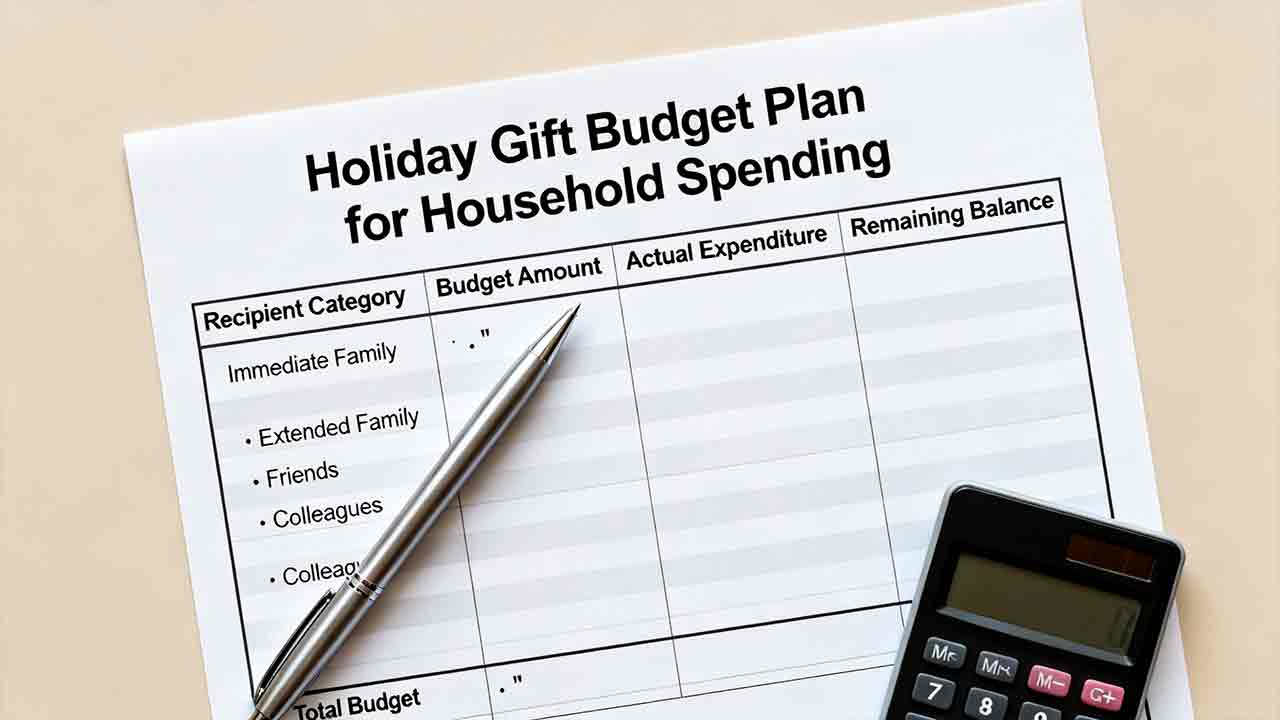
Holiday gift spending rarely begins with one dramatic mistake. More often, it grows through small, reasonable, emotionally understandable decisions: one extra teacher gift, one rush-shipping fee, one nicer wrapping paper bundle, one “we should bring something” grocery run, one last-minute gift card, one extra toy because the first gift looked too small.
None of those choices is automatically wrong. The problem is that most households build a gift budget around the gifts themselves, while the real holiday spending season includes much more than gifts.
A useful holiday gift budget has to protect the whole household, not just the shopping list. It should include the people you buy for, the way your household actually celebrates, the costs that appear around gifts, and the rituals that keep spending decisions from being made only at the busiest, most emotional moment of the season.
This guide offers a practical household gift-budget system designed for long-term use. It is not based on one holiday, one income level, or one perfect spreadsheet. It is built around a repeatable method: set the household limit first, separate gift costs from surrounding costs, assign each recipient a role, and review spending before the pressure rises.
The goal is not to make the holidays smaller or less generous. The goal is to make generosity easier to plan, easier to discuss, and easier to afford.
Who This Article Is / Is Not For
This article is for households that want a calmer way to handle holiday gift spending before the season becomes crowded with sales, social expectations, school events, work exchanges, travel, meals, donations, school reminders, and last-minute decisions.
It is especially useful if you have ever finished a holiday season wondering where the money went even though you did not buy anything extravagant. It is also useful if you share spending decisions with a partner, spouse, parent, roommate, adult child, or extended family member and need a shared system that feels practical instead of tense.
This article is for people who want a budget that includes real household life: gifts, cards, wrapping, postage, food contributions, small appreciation gifts, charitable giving, workplace exchanges, children’s activities, host gifts, and replacement costs when plans change.
This article is not for anyone looking for investment advice, tax advice, debt settlement advice, or a guaranteed way to afford every holiday wish list. It also is not a moral judgment about how much anyone “should” spend. A household with a $100 gift budget can be thoughtful. A household with a $2,000 gift budget can still need boundaries. The right number is the one that fits your real cash flow, obligations, values, and season.
If your household is behind on rent, utilities, food, transportation, insurance, medication, childcare, or other essentials, gift planning should not come before basic stability. In that case, this article may still help you organize expectations, but it should not replace direct help from a qualified financial counselor, nonprofit credit counselor, benefits office, or emergency assistance resource.
Quick Setup: Build Your Holiday Gift Budget in 20 Minutes
Use this utility box as a fast starting point before reading the full system.
Step 1: Choose one household number.
Write down the maximum amount your household can spend on holiday giving and related gift costs without delaying bills, using emergency savings, or relying on unpaid credit-card balances.
Step 2: Split the number into two parts.
Create one line for gifts and one line for gift-adjacent costs. Gift-adjacent costs include wrapping, cards, shipping, donations, tips, host gifts, school gifts, office exchanges, and food brought to gatherings.
Step 3: List every recipient group.
Do not start with names only. Start with groups: children, partner, parents, siblings, friends, teachers, coworkers, neighbors, service providers, hosts, charity, and unexpected obligations.
Step 4: Assign each group a role.
Use one of five roles: core, warm, symbolic, shared, or optional. Core gifts receive the most planning. Symbolic gifts receive a clear small limit. Optional gifts require a remaining-budget check.
Step 5: Add a small buffer.
Set aside 5% to 10% of the total holiday gift budget for forgotten costs. If your budget is very tight, the buffer can be a fixed amount, such as $15 or $25.
Step 6: Create a weekly check-in.
Pick one day each week to update the list, remove duplicate ideas, confirm shipping dates, and compare spending against the original limit.
Step 7: Decide your stop rule.
A budget without a stopping rule is only a wish. Your stop rule may be: “When the gift line reaches $600, all new gifts must come from swaps, homemade items, or unused budget from another line.”
The Real Holiday Gift Budget Is Bigger Than Gifts
A holiday gift budget often fails because the household only counts wrapped presents. But gift spending usually sits inside a larger circle of seasonal obligations.
A realistic household plan should include at least six spending zones.
First, there are primary gifts. These are the main presents for the people closest to your household. They usually receive the most attention and the highest spending limits.
Second, there are secondary gifts. These include gifts for friends, relatives, teachers, coaches, neighbors, coworkers, and people you appreciate but may not buy large gifts for.
Third, there are shared celebration costs. These are not technically gifts, but they often happen because of gift-giving occasions: a dish for a family dinner, sparkling cider for a host, extra groceries for visiting relatives, or decorations for a gathering.
Fourth, there are delivery and presentation costs. Wrapping paper, bows, cards, tape, postage, shipping, gift bags, boxes, and return shipping can quietly use money that was never assigned.
Fifth, there are social participation costs. Workplace exchanges, classroom events, holiday performances, donation drives, cookie swaps, and neighborhood gatherings can be small individually but significant together.
Sixth, there is the last-minute pressure zone. This includes emergency gifts, forgotten names, delayed packages, rushed delivery, replacement gifts, and “I need something today” purchases.
A stronger holiday gift-budget plan treats all six zones as part of one household system. This is what makes it different from a simple shopping list. A shopping list tells you what to buy. A budget system tells you when to stop, what to downgrade, what to combine, and how to keep one generous decision from quietly crowding out another essential expense.
The Household Gift Budget Ceiling
Use this original equation as the starting point:
Household Gift Budget Ceiling = Available Seasonal Cash - Protected Bills - Required Savings - Known Irregular Costs
This equation matters because many households choose a gift number by looking at what they want to spend instead of what the household can reasonably absorb.
Available seasonal cash is the money you reasonably expect to have during the gift-buying period after ordinary income timing is considered. If you are paid every two weeks, the timing of paychecks matters. If you rely on freelance income, commissions, tips, seasonal hours, or irregular payments, use conservative numbers.
Protected bills are the expenses that must not be disturbed by holiday spending. This includes housing, utilities, food, transportation, minimum debt payments, insurance, childcare, medical needs, phone service, and other household essentials.
Required savings may include emergency savings, upcoming insurance premiums, school fees, car maintenance, pet care, annual subscriptions, or property-related costs. A gift budget that empties your January money is not really a gift budget. It is a delayed household problem.
Known irregular costs are expenses that may not happen every month but are already visible: travel, winter clothing, vehicle registration, holiday school activities, medical copays, end-of-year memberships, or hosting costs. Here is a simple example:
A household expects $1,200 of flexible cash between early October and mid-December. It wants to protect $350 for January bills, $150 for car maintenance, and $100 for a winter utility cushion. That leaves $600 as the household gift-budget ceiling.
That $600 is not all for gifts. A stronger plan might divide it this way:
- $420 for actual gifts
- $80 for wrapping, cards, shipping, and delivery
- $50 for food, host gifts, or shared celebration costs
- $30 for school, work, neighbor, or appreciation gifts
- $20 for forgotten items or last-minute changes
This household may still be generous. But now generosity has a boundary.
For readers who want a general budgeting worksheet from a public consumer source, the Consumer Financial Protection Bureau provides a downloadable budget worksheet here: [CFPB Your Money, Your Goals Budget Worksheet](https://www.consumerfinance.gov/documents/5176/cfpb_ymyg_budget-worksheet.pdf).
Build the Gift List by Role, Not by Emotion
Many holiday budgets begin with names. That sounds logical, but names carry emotion. When every person appears as an individual line, it is easy to overcorrect: one person looks underfunded, another looks forgotten, and the list grows before the household has decided what the season can afford.
Instead, start with roles.
Core Gifts
Core gifts are for the people your household has clearly chosen as the main focus of holiday giving. This might include children, a spouse or partner, parents, or a small group of close relatives. Core does not mean expensive. It means planned first.
A core gift should have a clear ceiling, a purchase window, and a fallback idea. For example: “Child A: $120 maximum, buy by November 25, fallback is one book plus one activity gift.”
Warm Gifts
Warm gifts are meaningful but lower-pressure gifts. These may include siblings, close friends, grandparents, cousins, or relatives you see during the season. Warm gifts can often work well as shared gifts, consumable gifts, framed photos, family recipe items, books, or experience-related gifts.
Symbolic Gifts
Symbolic gifts are small gestures meant to show appreciation, not compete with primary gifts. Teachers, coaches, neighbors, mail carriers where allowed, office staff, and casual friends may fall into this group. A symbolic gift works best when the limit is set before shopping begins.
Shared Gifts
Shared gifts are given to a household, couple, classroom, team, or group. They are useful when the recipient list is large but the relationship is collective. A breakfast basket for a family, a board game for cousins, or a classroom supply contribution can reduce spending while still feeling thoughtful.
Optional Gifts
Optional gifts are only purchased after the core, warm, symbolic, shared, and surrounding costs are covered. This category protects the budget from expanding simply because an idea feels nice in the moment.
The role system lowers emotional friction. It allows you to say, “This is a symbolic gift category,” instead of, “This person is not important.” That distinction matters.
The Holiday Spending Map
Create a one-page map with four columns:
Recipient / Category Role Limit Decision Status
The decision status should use plain labels:
- Not started
- Idea chosen
- Price checked
- Purchased
- Wrapped or delivered
- Removed
- Combined with another gift
This map prevents three common problems.
First, it prevents duplicate buying. A household may buy a gift in October, forget about it, and then buy another gift in December.
Second, it prevents “almost done” confusion. A gift is not complete if it still needs wrapping, shipping, batteries, assembly, a card, or delivery.
Third, it prevents vague remaining-budget math. If the total gift ceiling is $420 and you have assigned $390, the remaining decision is clear. You have $30 left unless another line is reduced.
The map can live in a notebook, spreadsheet, notes app, printed worksheet, or shared household document. The tool matters less than the ritual of updating it.
The Four Gift-Budget Rituals
A holiday budget works best when it becomes a rhythm, not a one-time calculation. Use these four rituals through the season.
1. The October Boundary Ritual
In early October, set the total household ceiling. This should happen before heavy holiday advertising, major sales events, and family pressure begin.
The conversation should answer four questions:
What can we spend without touching protected bills? Which people or traditions matter most this year? Which categories need smaller symbolic gestures? What are we not doing this year?
The last question is the most powerful. A budget is not only a list of yeses. It is also a list of planned noes.
2. The November Reality Ritual
In November, check prices against the original plan. Some gifts may cost more than expected. Some may be unavailable. Some may no longer feel necessary.
This is the moment to adjust before panic begins. If one core gift rises by $40, decide which category will absorb the change. Do not let the increase float unassigned.
3. The December Stop Ritual
In December, shift from shopping mode to completion mode. The question changes from “What else should we buy?” to “What still needs to be finished?”
This ritual helps prevent late-season budget creep. Many households overspend not because they failed to buy gifts, but because they kept buying after the gift list was already complete.
4. The January Memory Ritual
In January, write down what actually happened. Keep it short.
What did we spend? Which categories surprised us? Which gifts were most appreciated? Which costs did we forget? What should next year’s first number be?
This review turns one holiday season into useful household knowledge. Without it, every year starts from memory and emotion again.
What NOT To Do / Common Mistakes
Mistake 1: Starting With Sales Instead of Limits
A sale is not a budget. A discounted item still uses household money. Starting with sales can make spending feel responsible even when the total is rising beyond the household limit.
Set the ceiling first. Then use sales only if they help you stay inside it.
Mistake 2: Treating Gift Cards as Effortless Gifts
Gift cards can be practical, but they still require care. Check the card packaging before purchase, keep the receipt, and avoid buying gift cards in response to urgent payment requests.
For general safety reading, the Federal Trade Commission provides consumer guidance on gift-card scams and safe gift-card buying. These resources are useful reminders because gift cards are often involved in last-minute holiday purchases and payment-pressure scams. See the FTC’s consumer information here: [Gift Card Scams](https://consumer.ftc.gov/articles/gift-card-scams) and [Gift Cards](https://consumer.ftc.gov/articles/gift-cards).
Mistake 3: Forgetting the Cost of Giving the Gift
A $35 gift may become a $52 gift after tax, wrapping, shipping, and a card. If the recipient lives far away, the delivery cost may be part of the gift decision.
For mailed gifts, compare the total cost of buying locally and shipping versus ordering directly to the recipient. The cheaper item is not always cheaper after delivery.
Mistake 4: Making Every Gift Equal
Equal spending is not always fair or useful. A teenager’s needed item may cost more than a toddler’s toy. A family gift may cover several people at once. A symbolic thank-you gift should not compete with a child’s main gift.
Instead of forcing equal amounts, aim for clear intention and household agreement.
Mistake 5: Letting Children’s Lists Become the Budget
Wish lists can be helpful, but they are not spending plans. A child may list more items than the household can reasonably buy. The parent or caregiver’s job is not to fulfill the full list. It is to choose within the household’s limit.
A helpful rule is: one wanted item, one useful item, one shared activity, or one surprise. The exact formula can change, but the limit should be clear.
Mistake 6: Ignoring Returns and Exchanges
Return windows, receipts, shipping deadlines, and exchange rules matter. A gift that cannot be returned may still be fine, but the decision should be intentional. Keep receipts in one envelope, folder, or digital album.
Mistake 7: Using Credit Without a Payoff Plan
Credit cards can be payment tools, but they are not extra holiday income. If you use a credit card, decide how and when the balance will be paid. If the plan is vague, the gift may cost more than its purchase price.
The Gift Budget Tiers
If you are unsure how to divide the total, use a tiered structure.
Tier 1: Essential Relationship Gifts
These are the gifts most aligned with your household values. They are planned first and protected from last-minute spending.
Examples include children’s gifts, a partner gift, gifts for parents, or one meaningful gift for a close friend.
Tier 2: Appreciation Gifts
These are kind gestures for people who support your household or community. They should have modest, consistent limits.
Examples include teachers, coaches, neighbors, babysitters, workplace helpers, or building staff.
Tier 3: Participation Gifts
These gifts help you participate in events without overspending.
Examples include office gift exchanges, classroom exchanges, cookie swaps, white elephant parties, or group baskets.
Tier 4: Optional Joy Gifts
These are extra items that feel fun but are not necessary. They are allowed only if money remains after other categories are complete.
Examples include stocking stuffers, extra decorations, novelty items, upgraded wrapping, or spontaneous gifts.
This tiered approach helps you reduce spending without feeling like every cut has the same emotional weight.
A Practical Household Example
Imagine a household with two adults, two children, several relatives, school gifts, and one workplace exchange. The household chooses a total holiday gift-related ceiling of $750.
These numbers are only an example, not a recommended spending target. A smaller or larger plan can be equally valid if it fits the household’s real cash flow.
The household divides it this way:
- Children: $240
- Partner gifts: $100
- Parents and grandparents: $120
- Siblings and close relatives: $90
- Teachers and school helpers: $40
- Coworker exchange: $25
- Friends and neighbors: $40
- Wrapping, cards, and postage: $45
- Host gifts and food contributions: $35
- Buffer: $15
At first, the $15 buffer looks small. But the point of a buffer is not to fund a second holiday. It is to prevent one forgotten cost from breaking the plan.
In November, one child’s gift costs $20 more than expected. The household has three choices:
Reduce another child’s gift, which may not feel right. Use the buffer and reduce wrapping costs. Change the gift idea before buying.
Because the budget is visible, the decision becomes a tradeoff instead of a surprise.
This is the purpose of a household gift budget. It does not remove emotion. It gives emotion a place to stand.
The “Small Gifts” Rule
Small gifts are often the most dangerous category because they feel harmless.
A $7 candle, a $6 ornament, a $9 box of chocolates, a $5 card, and a $12 gift bag can become a meaningful total when repeated across many people. The issue is not the kindness. The issue is repetition without counting.
Use the small gifts rule:
Any gift under $15 still goes on the list.
This rule may feel unnecessary at first, but it prevents invisible spending. It also helps you see patterns. If you are buying ten small gifts for people in the same group, a shared gift may be better.
For example, instead of six separate $12 neighbor gifts, you might host a simple cocoa evening, deliver one shared baked item per household, or write personal cards. The best choice depends on your relationships, time, and household budget.
How to Handle Family Expectations
Gift budgets often become difficult because money is mixed with tradition, love, pride, and family history. A household may want to spend less but fear that relatives will misunderstand.
The most effective approach is to communicate early and calmly. Do not wait until gifts have already been purchased by others.
Useful phrases include:
“This year we are keeping gifts simple and focusing on time together.” “We are doing gifts for children only this year.” “We are setting a small limit for adult gifts so everyone can relax.” “Would you be open to a shared meal or family activity instead of individual gifts?” “We are doing cards and photos this year rather than mailed packages.”
The goal is not to explain your entire financial life. The goal is to set a clear expectation before others assume the old pattern will continue.
If your family enjoys gift exchanges, consider a name draw, spending cap, handmade exchange, recipe exchange, book swap, ornament exchange, or shared charity contribution. A spending cap is most useful when it is specific.
“Let’s keep it small” means different things to different people. “Let’s keep adult gifts under $25” is clearer.
How to Budget for Children Without Losing the Household Plan
Children’s gifts can create the strongest pressure because parents and caregivers often want the season to feel magical. A budget does not have to remove that feeling. In many households, children remember rituals as much as price: pancakes in pajamas, a drive to see lights, a movie night, a handwritten note, a favorite dessert, or permission to choose the family game.
Try dividing children’s gifts into categories instead of only dollar amounts:
A wanted item A useful item A reading or learning item A shared activity A small surprise
This structure helps prevent a pile of unrelated items from replacing a thoughtful plan. It also makes it easier to stay within limits when one item costs more than expected.
If children are old enough, you can introduce budget awareness without placing adult stress on them. For example: “We are choosing a few special things this year, not everything on the list.” This teaches limits without making the child responsible for household finances.
How to Use a Gift Drawer Without Overspending
A gift drawer can save money or create clutter, depending on how it is managed.
A useful gift drawer contains items you already have a likely recipient or purpose for: blank cards, neutral wrapping supplies, a few children’s birthday gifts, hostess items, or small appreciation gifts.
A risky gift drawer contains items bought only because they were discounted. If the item has no likely recipient, it is not savings. It is stored spending.
Use three rules:
Do not buy for the gift drawer unless you can name the future purpose. Check the drawer before buying new gifts. Remove items that no longer fit your household, relationships, or storage space.
A gift drawer is not a substitute for a budget. It is a support tool.
The Holiday Gift Budget Worksheet
Copy this worksheet into a notebook or spreadsheet.
Household holiday gift ceiling: $_____ Gift spending limit: $_____ Gift-adjacent spending limit: $_____ Buffer: $_____
| Recipient or Category | Role | Limit | Gift Idea | Status | Actual Cost |
|---|
| Child / dependent | Core | $ | | | $ |
| Partner / spouse | Core | $ | | | $ |
| Parent / grandparent | Warm | $ | | | $ |
| Sibling / relative | Warm | $ | | | $ |
| Teacher / coach | Symbolic | $ | | | $ |
| Coworker exchange | Participation | $ | | | $ |
| Neighbor / friend | Symbolic | $ | | | $ |
| Host gift / food | Shared | $ | | | $ |
| Cards / wrapping | Support cost | $ | | | $ |
| Shipping / postage | Support cost | $ | | | $ |
| Unexpected | Buffer | $ | | | $ |
Weekly Review Questions
What did we buy this week?
What did we almost buy but skip?
Which gift is still missing a decision?
Which cost was higher than expected?
Do we need to reduce, combine, or remove anything?
Are we still inside the household ceiling?
The most important line is not the gift idea. It is the actual cost. A budget becomes real only when estimated costs are replaced by actual numbers.
What This Article Does Not Claim
This article does not claim that every household should spend the same amount on gifts.
It does not claim that holiday giving is required.
It does not claim that budgeting removes financial stress, family pressure, inflation, income uncertainty, or personal hardship.
It does not provide investment advice, tax advice, legal advice, credit counseling, debt settlement advice, or individualized financial planning.
It does not recommend using credit, loans, buy now pay later services, or emergency savings for gifts.
It does not claim that a specific gift budget will lead to financial success, family harmony, or a perfect holiday season.
It offers an educational household budgeting framework that readers can adapt to their own circumstances.
Why You Can Trust This Article
This guide was prepared as an evergreen household budgeting resource, with a focus on practical planning, clear limits, and repeatable spending rituals rather than financial product promotion.
The method in this article is based on a clear household-budget principle: spending decisions should be made after essential obligations are protected. The article also separates gifts from gift-adjacent costs, which is a common source of household budget drift.
The frameworks used here, including the Household Gift Budget Ceiling, the role-based recipient system, the four gift-budget rituals, and the small gifts rule, are original editorial tools created for this article. They are designed to help readers make clearer spending decisions without pretending that every household has the same income, family structure, cultural tradition, or holiday expectation.
Where outside references are useful, this article points readers to recognized consumer-information sources, including the Consumer Financial Protection Bureau for budgeting tools and the Federal Trade Commission for gift-card safety awareness. For broader household finance context, readers can also review the Federal Reserve’s public household financial well-being research: [Economic Well-Being of U.S. Households in 2024](https://www.federalreserve.gov/publications/2025-economic-well-being-of-us-households-in-2024.htm).
How This Article Was Reviewed
This article was reviewed for practical household use, clear budgeting math, legal safety, and long-term usefulness.
The review checked that the title, category, author, and publication date were consistent with the article’s purpose. It also checked that the article does not rely on events after October 8, 2025, and does not make time-sensitive claims that would quickly become outdated.
The budgeting examples were reviewed to make sure the numbers are illustrative, not promises. The article was also reviewed to avoid encouraging debt, shame-based spending, unrealistic savings claims, or one-size-fits-all financial rules.
The consumer-safety references were selected because holiday gift spending can involve gift cards, online purchases, shipping, and last-minute pressure. The article links to official consumer resources rather than commercial shopping pages.
FAQ
How much should a household spend on holiday gifts?
There is no universal amount. A useful holiday gift budget depends on income timing, essential bills, savings needs, household size, existing obligations, and personal values. The best starting point is not what other people spend. It is the amount your household can spend without delaying bills, using emergency savings, or creating debt you cannot pay off as planned.
What if my holiday gift budget is very small this year?
A small gift budget can still support a thoughtful season. Start by protecting essentials first, then choose one or two meaningful gestures instead of trying to cover every old tradition. Consider cards, shared meals, homemade items using supplies you already own, children-only exchanges, family name draws, or one group gift per household. The goal is not to match a previous year. The goal is to give in a way that does not create avoidable financial strain.
Should holiday food and hosting costs be part of the gift budget?
If those costs happen because of the holiday gift season, they should be included somewhere in the seasonal plan. They do not have to come from the gift line, but they should not be ignored. A dish for a gathering, a host gift, extra snacks for guests, or supplies for a gift exchange can affect the household budget just as much as a wrapped present.
Is it better to buy gifts early?
Buying early can help if you have a list, a limit, and a tracking system. Buying early can hurt if it simply extends the shopping season and gives you more time to add extra items. Early buying works best when each purchase is recorded immediately and tied to a specific recipient or category.
How do I stop last-minute overspending?
Create a stop rule before December. For example: “After the gift budget reaches $500, any new gift must replace an existing gift or come from the buffer.” Also switch from shopping mode to completion mode. Ask what needs wrapping, mailing, labeling, or returning instead of asking what else could be bought.
What if my partner or family member spends more than planned?
Use the written budget as a shared reference rather than making the conversation personal. Instead of saying, “You always overspend,” try, “Our gift line has $80 left. If we add this, which line should we reduce?” The goal is to turn conflict into a tradeoff decision.
Are homemade gifts always cheaper?
Not always. Homemade gifts can be meaningful, but supplies, tools, ingredients, packaging, and time can add up. A homemade gift should still have a budget. If you already own the supplies or can make several gifts from one batch, it may be cost-effective. If you need to buy many new materials, compare the full cost first.
Should I use a credit card for holiday gifts?
A credit card may be a payment method, but it should not be treated as extra income. If you use one, write down the payoff plan before purchasing. If you do not know how the balance will be paid, reduce the gift plan before spending.
How can I make a smaller holiday budget feel thoughtful?
Use specificity. A handwritten note, a favorite snack, a framed photo, a shared activity, a useful item, or a carefully chosen book can feel more personal than a higher-priced generic gift. Thoughtfulness often comes from attention, not price.
What is the easiest way to reduce the list without hurting feelings?
Reduce by category, not by person. For example, suggest “children only,” “one family gift per household,” “adult name draw,” or “cards instead of mailed gifts.” Category changes feel less personal than removing individual names.
When should I start next year’s holiday gift budget?
Start the January memory ritual right after the season ends. You do not need to build the full budget in January, but you should record what surprised you while the memory is fresh. Then set the first household ceiling in early October before seasonal pressure builds again.
Final Takeaway
A strong holiday gift budget is not a punishment. It is a household agreement.
It lets you decide what matters before advertising, guilt, comparison, and last-minute pressure make the decisions for you. It also protects the parts of your financial life that still matter after the decorations are put away: rent or mortgage payments, groceries, transportation, utilities, savings, debt payments, and peace of mind.
If you remember only one system from this guide, make it this simple sequence:
Choose the household ceiling. Separate gifts from surrounding costs. Sort recipients by role. Track actual spending. Review weekly. Stop when the plan says stop. Write down what to remember for next year.
Holiday giving works best when it reflects care without creating avoidable strain. A budget does not make gifts less meaningful. It helps your household give with intention, finish the season with fewer surprises, and carry the habit into the next year.